
Call us:
0704386039

Call us:
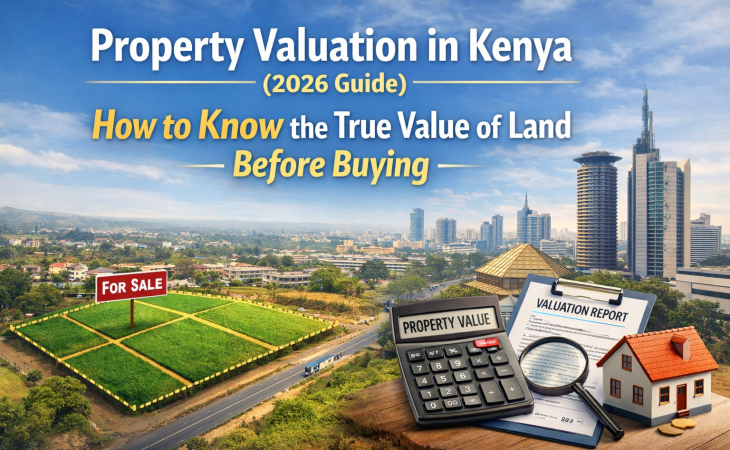
Buying land in Kenya is widely considered one of the safest long-term investments. Over the past two decades, land prices around major urban centers such as Nairobi have grown significantly due to population growth, infrastructure expansion, and increased demand for housing and commercial developments.
However, despite the potential for strong returns, many property buyers still make costly mistakes when purchasing land. One of the most common problems is paying far above the true market value of a property.
In many cases, buyers rely solely on information provided by brokers or sellers without conducting independent research or professional valuation. As a result, some investors end up paying inflated prices or purchasing land in locations with limited growth potential.
Understanding how property valuation works in Kenya is therefore essential for anyone planning to buy, sell, or invest in real estate.
This comprehensive guide explains everything you need to know about property valuation in Kenya, including:
By understanding these concepts, buyers and investors can make more informed decisions and avoid costly property investment mistakes.
Property valuation refers to the process of determining the current market value of land or real estate based on various economic, legal, and physical factors.
In simple terms, valuation answers the most important question in real estate:
“How much is this property truly worth in today’s market?”
Professional property valuation in Kenya is carried out by licensed valuers who analyze multiple factors including location, comparable property sales, infrastructure development, and land use regulations.
Valuation reports are commonly used by:
In many situations, a formal valuation report is required before a transaction can proceed.
For example, banks require valuation reports before approving mortgage loans to ensure the property being used as collateral has sufficient value.
Understanding property valuation is critical for several reasons.
In rapidly developing areas around Nairobi, land prices can vary significantly depending on infrastructure, accessibility, and neighborhood development.
Without proper valuation, buyers may unknowingly pay 20–40% above the actual market price.
Sellers also benefit from professional valuation because it helps them set realistic property prices that attract buyers while avoiding underpricing.
Financial institutions require valuation reports before approving property loans. The valuation helps determine whether the property provides adequate loan security.
Professional valuation helps investors identify areas with strong future growth potential.
Investors who understand property valuation are better positioned to identify undervalued opportunities.
Valuation reports are also used in:
Licensed property valuers use several methods to determine the value of land or property. The method used often depends on the type of property being evaluated.
The three most common valuation approaches include:
The market comparison method is the most commonly used approach for valuing residential land and houses.
This method estimates property value by comparing it with similar properties that have recently sold in the same location.
Factors considered include:
If several 50 × 100 plots in Ruiru recently sold for between KSh 2.8M and KSh 3.5M, a similar plot nearby would likely fall within that price range.
Because this method is based on actual market transactions, it is widely accepted by banks and investors.
The income approach is mainly used for properties that generate rental income such as:
Instead of comparing property sales, this method estimates the property’s value based on the income it generates.
If a commercial property generates KSh 800,000 in annual net rental income, and the capitalization rate is 10%, the estimated property value would be:
KSh 8,000,000
This method is widely used by investors evaluating commercial real estate opportunities.
The cost approach estimates the value of a property based on how much it would cost to rebuild the structure today.
This includes:
Depreciation is then deducted depending on the age and condition of the property.
If constructing a similar house today costs KSh 10 million, and depreciation is estimated at 20%, the adjusted value would be KSh 8 million.
Property values in Kenya are influenced by several key factors.
Understanding these factors can help investors identify areas with strong investment potential.
Location remains the most important factor affecting property value.
Land located near:
usually commands higher prices.
Satellite towns near Nairobi such as Ruiru, Kitengela, Juja, Ngong, and Athi River have experienced rapid price appreciation due to urban expansion.
Infrastructure plays a major role in determining land value.
Access to services such as:
can significantly increase property prices.
Large infrastructure projects such as highways, bypass roads, and railways often trigger rapid increases in land values.
Land designated for commercial or mixed-use development is often more valuable than purely residential land.
Areas where apartment construction is permitted typically attract property developers.
Regular-shaped plots are easier to develop and therefore tend to be more valuable.
Plots with irregular shapes, steep terrain, or poor road access may have lower development potential.
Population growth and urbanization have significantly increased land demand around major cities.
Areas experiencing rapid population growth usually see steady property price appreciation.
Below is an approximate guide to average land prices for 50 × 100 plots around Nairobi.
| Location | Average Price |
|---|---|
| Ruiru | KSh 2.5M – 4M |
| Kitengela | KSh 1.5M – 3M |
| Juja | KSh 700K – 2M |
| Ngong | KSh 2M – 3.5M |
| Athi River | KSh 1.5M – 3M |
| Ruai | KSh 1.2M – 2.5M |
Prices vary depending on proximity to roads, infrastructure, and neighborhood development.
Property valuation fees in Kenya vary depending on the property size, location, and complexity of the valuation.
Typical valuation costs range between:
KSh 10,000 and KSh 50,000
Some commercial property valuations may cost more depending on the scale of the project.
Before purchasing land in Kenya, buyers should take several important steps to estimate the property’s true market value.
Look at land transactions within the same area over the past 6–12 months.
Inspect the land to confirm:
Confirm that the title deed is genuine and that the seller has legal ownership.
Upcoming infrastructure projects can significantly influence property value.
A licensed valuer can provide a formal valuation report recognized by banks and financial institutions.
Even experienced investors sometimes make valuation mistakes.
Avoid these common errors:
Some brokers inflate prices to increase commissions.
Failure to verify ownership can expose buyers to fraud or disputes.
Rapid land price increases can sometimes be driven by speculation.
Land without proper road access or utilities may be difficult to develop.
Traditional property valuation focuses mainly on determining market price.
However, price alone does not tell the full story about a property’s investment potential.
This is where LanDeals Property Intelligence provides a more comprehensive approach to evaluating land investments.
LanDeals analyzes properties using a multi-factor assessment model that evaluates both value and risk.
Before recommending a property investment, LanDeals evaluates seven key factors:
| Factor | What It Measures |
|---|---|
| Title Authenticity | Verification of land ownership records |
| Ownership History | Past ownership and transaction records |
| Access Infrastructure | Road access and transport connectivity |
| Utilities Availability | Electricity, water, sewer connections |
| Zoning Compliance | Approved land use regulations |
| Market Price Fairness | Comparison with recent sales |
| Dispute Risk | Potential legal or boundary conflicts |
Each factor is analyzed to produce a Land Risk Score that helps buyers understand the overall safety of a property investment.
| Risk Category | Score |
|---|---|
| Title Verification | Low Risk |
| Ownership History | Low Risk |
| Infrastructure | Moderate |
| Market Price | Fair Value |
| Legal Dispute Risk | Low Risk |
Overall Rating:
8.4 / 10 — Low Risk Investment
This approach allows buyers to evaluate property based not only on price but also on legal security and long-term investment potential.
Property valuation is the foundation of every successful real estate investment.
Understanding how land value is determined helps buyers:
However, price alone is not enough.
Smart investors also evaluate legal security, infrastructure access, and long-term market trends before purchasing land.
By combining professional valuation with comprehensive due diligence, investors can make safer and more profitable real estate decisions in Kenya.
LanDeals offers genuine and affordable properties for sale in fast-growing areas, with transparent processes and expert support throughout your journey. Call Us on 0704386039
Leave Your Comment